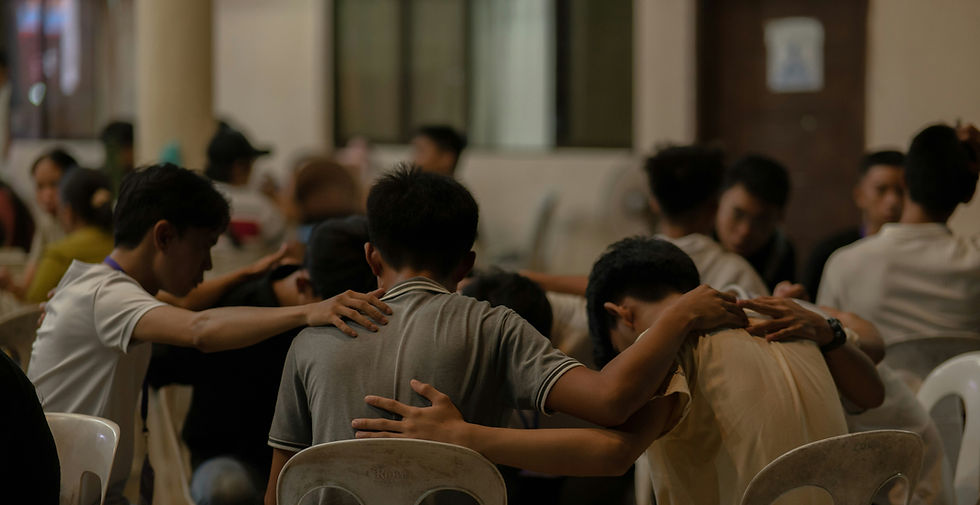
Life Support At The End of The Age


"Each of you should use whatever gift you have received to serve others, as faithful stewards of God’s grace in its various forms." 1 Peter 4:10
Main Readings: John 13:1-17 & 1 Peter 4
Supporting Readings: Romans 12 & Psalm 84
We have good cause to get excited about the passage in front of us this morning.
When you see the writer of scripture getting excited, it’s a cue to us to get excited too. And Peter gets excited here. Really excited.
He finishes this paragraph with doxology. And that should alert us to the fact that there are just glorious truths in this paragraph that are worthy of Peter’s worship at the end of them. ‘To him be glory and power for ever and ever’ Peter concludes, in verse 11.
So, I want to alert us from the outset this morning, there are glorious things here that Peter thought worthy of doxology, and we absolutely should too. My prayer is that I can capture them for us, and not obscure them!
Right here at the outset though, let’s not lose sight of Peter’s train of thought as it has come down to us thus far.
Let’s not forget that he’s been exhorting us to good Christian conduct, even in the face of suffering. Good conduct for the sake of the world and for the lost around us.
Peter wants them to be compelled by Christ - by Christ being seenin us. And he wants it, so that Christ might be glorified on the day of his appearing.
We saw last time, when Dave preached for us, that Christ’s example of suffering continues to inform our Christian life here below – in this world; which is not our home.
And the exhortation in verse two, last time, came across loud and clear: live for the will of God.
When we suffer in the body for Christ, we show that we are done with sin. We show we have the same attitude as Christ Jesus who suffered in his body to do away with our sin.
And now, with that as the backdrop, Peter is turning the focus from the outside world, to show us what this kind of living for the will of God looks like inside - inside the church.
So that’s our focus this morning – the church of Jesus Christ and how Christ’s example functions for us in that setting also.
Peter’s going to talk about prayer; about love; about hospitality; about gifts; and about the glory of Christ.
And you might be left wondering, ‘what are you aiming at here Peter?’ ‘How are these things connected and why do you focus on these, and not other things?’
I don’t think Peter is random. And I don’t think his thoughts are unconnected.
He wants us to grasp something crucial. And it’s safe to say, glorioustoo. So, we’ve got to try to figure out what Peter’s unified thought ishere.
We could easily be thrown, from the get go, by the first sentence in verse 7. ‘The end of all things is near’.
That’s quite an odd thing to say. Especially when we think that we are some 2,000 years further out from Christ than Peter was.
‘If the end of all things was near in Peter’s day, then why hasn’t the end already come?’ is a good question.
Well, someone once said that things are relative.
I don’t know much about general relativity, but I do know, that where God is concerned, time is relative.
He says, ‘with the Lord a day is like a thousand years, and a thousand years are like a day’ (2 Peter 3:8).
Therefore, in God’s measure, it may only have been two days since Peter wrote these words and not 2,000 years as we so scantily perceive it.
And therefore, it is certainly safe to say, with Peter, ‘the end of all things in near’.
What he means by the phrase is one thing; but the reason for the phrase is another important matter. Why does Peter adopt this phrase at this moment in his letter?
Well, it is to say this: we are, and have been, ever since Jesus’ ascension, in the very last days of this age.
There is an age that is now and there is an age to come. The age that is now, extends from the creation of the world to the second coming of Jesus. And the age to come begins with the second coming of Jesus.
And we are in the last days of this current age. Just like Peter was in his day.
And what is it that characterises these last days of the age? In verse 17 Peter tells us: ‘It is time’ he says, ‘for judgment to begin with God’s household’.
God’s household is the household of believers – you and me who belong to Jesus. And though judgement is coming on that day when Jesus returns, there is a kind of judgment that starts with his very own people, now.
That doesn’t mean they suffer as a punishment. It means that God has ordained suffering for them, in this world – we saw that back in chapter 2 – so that they might bear witness to this lost world. A world that will suffer – for all eternity – if they don’t find Christ now.
So, Peter is telling us that the end of all things is near, to remind us that suffering for Christ has been ordained for us, now.
And as he turns our attention to what living for the will of God looks like in the church, he doesn’t want us to forget that suffering, discomfort, self-abasement is the call God has made on our lives in the times that he has ordained for us to live in.
This reminder is going to help us as we move forward in this passage. Love and hospitality and service are on the table here, and we’re being told that these things are going to be costly.
It’s preparation for our souls, for what comes next.
‘The end of all things is at hand – you know what to expect’ Peter says.
Now, it’s in this very knowledge that Peter exhorts us to pray. He says, ‘because these are testing times for you, nothing at all can be done that is of lasting worth, without wholesale reliance on God’.
If we try to go it alone in the face of this demanding time that we live in, we’ll throw in the towel for sure.
I mean it’s so easy to conceive of how much more smooth life would be if we didn’t have to suffer like Christ, for Christ.
Many have thrown in the towel because of that very appealing and alluring notion.
Peter says, ‘you’re in the thick of it – the end of all things is near. If you don’t pray, you’ll be going it alone. And in that state, you’ll throw in the towel’.
So straight away, what we’ve all got to be doing, all the time, is praying.
Pray that God would sustain your faith.
Pray that God would help you not to count it too costly to follow Jesus.
Pray that God would maintain the vivid nature of the awesome promises of eternal life that he has made you.
Pray that God would give you grace to remain on the narrow path – even though it leads through valley of the shadow of death.
All kinds of prayers that serve to keep us in the fight, in this unbelievably challenging time that we live in.
Now notice that the mind serves prayer. Peter says ‘be alert and of sober mind so that you may pray’.
Prayer is supported by a sound mind. A mind that is alert and sober.
Peter said this once already back in chapter 1, verse 13 and he’ll say it again before the end of the letter, in chapter 5, verse 8.
And we shouldn’t miss repetition like that – he wants us to remember this. It’s important enough to repeat.
Back in chapter 1 this alertness and soberness was so that we could set our hope on the grace to be brought to us when Christ Jesus is revealed at the second coming.
In other words, if we want to be able to function effectively as Christians in this world, we’re going to need to be able to fix our attention on unseen things. Like the return of Jesus for example.
It’s the same in chapter 5. There, in the spiritual realm which can’t be seen, is a powerful enemy; a roaring lion-of-an-adversary, who is looking to devour our faith. An alert and sober mind enables us to seehim and to resist him.
And here, that kind of mind allows for prayer. And I think the point is, that without that kind of mind we won’t know to pray because we won’t be aware that we’re in these very last days of the age which are getting worse.
If we have a mind that is drunk with this world, then we do not have a sober mind.
And in that case, we cannot be alert to the times; to the spiritual forces in the heavenly realms, or to the amazing grace that is coming to us down the line when Christ returns.
This appeal to a sound mind, is an appeal to a spiritual mindset that is not drunk on materialism; not drunk on success; not drunk on fame; not drunk on entertainment. Or anything else that is not of God.
It’s an appeal to a mind that is fixed on spiritual things not temporal things.
We can’t pray without this kind of mind.
So that’s going to be crucial.
How do we get that kind of mind?
I think that if we follow Peter’s vision for us in this passage, we will find that such a mind will develop.
And it will become a kind of cycle of, right mind-set feeds prayer, which supports nourishment, which improves mind-set, which feeds prayer, which supports nourishment, and so on. A cycle of life support if you will, that carries on our whole Christian life.
If we attend to as we should!
So, nothing that follows on in Peter’s vision for our good here, happenswithout the powerful enterprise of prayer. This whole passage startswith God and ends with God.
We need God. We need prayer.
What does follow here is a kind of church recipe for encouraging embattled believers, like us, who are weary travelers in this world, topersevere to the very end.
Peter’s got in mind the kind of person who is living and suffering for Christ in the world, and who is in need of encouragement and support.
One who needs nourishing. Whose weak knees need strengthening for the onward journey. Someone who gets to come into this haven of God’s goodness and blessing, and be helped.
Look at the very end of verse 10 and you’ll see that God’s grace in its various forms is what gets distributed in this environment to people like us.
We should grasp this. Grace is not just the forgiveness of sins. Grace is also everything God gives us on account of forgiven sins. And that comes in many forms Peter says!
I wonder if that’s how we view church?
Is the church that place where we come in from the howling wind and the battering rain of the world and get dried off?
Is it the place where we get nourished and helped? A place where our strength is renewed for the rest of the journey? Is it that place where God’s grace, in its many forms, flows into our lives?
I hope that’s how you see the church, because that is, at least, one of its key functions.
Let’s learn together how it functions and what our role is within that functioning.
Verse 8 has love. Verse 9 has hospitality. Verse 10 has service. Verse 11 has detail about that service.
These are instructions for how the church should function for the building up of Christians in this great struggle that we are called to walk in for Christ.
So, first - at the heart level – ‘love one another deeply because love covers over a multitude of sins’.
It would be absolutely no good, would it, if, when we’ve been out in the world suffering for Christ in all kinds of ways, if then when we came into this haven for rest, we found ourselves in the trenches with our fellow believers as well! No good at all!
That would serve nobody well. And it wouldn’t advance Christ’s kingdom or honour him in any way.
The church needs to be a place that, when we come in, is marked by peace, and rest, and by love.
Now we all know that in any community of sinful people, there are going to be problems.
Disagreements, harsh words, careless behaviour, all kinds of clashes. That’s normal.
And Peter knows that too.
So, there must be a mechanism for ensuring that this community – this prime community; this community unlike any other community on earth – that this community can operate without trench warfare in its ranks.
And Peter says there is!
It’s: loving each other deeply from the heart.
Not only will deep love for each other help us guard against harshness and carelessness and rudeness. But Peter’s main point is, that when that stuff comes at us – which it will; no excuses for it, but it will come – that our response to that offence, in love, is a response that can overlook sin.
Love overlooks sins against us.
Christ Jesus is our example here.
He was mistreated by his people - worse than we ever have been or will be - but he suffered for our sins that we might be rescued from our sins.
Here’s what you can do when a brother or sister sins against you: you can go to that brother or sister, and you can say, ‘what you did [or what you said] really hurt me.
But I remember that my sins against Jesus really hurt him – wayworse than anything I’ve experienced.
I remember that he went to the cross and took the punishment for my sins on himself and covered the multitude of my sin.
I therefore forgive you, as I have been forgiven’.
You know what? I think that brother or sister would probably be cut to the heart by a response like that. And would probably repent and find healing for that sin in the precious grace of Jesus.
And just imagine how much warfare could be avoided in church life if we were quick to do that kind of thing, rather than getting all bent out of shape with each other.
Love each other deeply – real; authentic love - because love covers over a multitude of sins.
Can I point out that Peter is showing that, even within the haven that is the church, life here below is costly.
It will cost us our pride to love someone enough to forgive them their sins against us in the interests of Christ-like love and harmony. It really will.
Living for the will of God is costly.
But love shouldn’t stop there. Love should come to expression where it’s on the front foot. Not just reactive - like when someone sins against us - but also proactive.
Specifically, Peter urges that love come to expression in hospitality.
Now, I completely accept and, indeed, endorse the idea that hospitality has lots of different expressions.
You can be hospitable by sharing your car with someone. You can be hospitable by making someone a meal when they’re sick. You can be hospitable by helping someone with their washing.
But I do think that what Peter has in mind here is opening up our homes to each other.
What is coming next in Peter’s vision for our church life-support happens most naturally in the setting of open homes and gatheredbelievers.
And isn’t it just so true that when we think of doing that very thing – opening up our homes – so many objections rise up in our hearts? Isn’t that so?
‘My house is too small. My house is too messy. What will they think of my décor? It’s not convenient. Tonight’s not the night’.
Just ten thousand reasons not to do it.
That’s natural. But it’s not good. And that’s why Peter says, ‘when you do it, do it without grumbling’.
It would be so easy to do hospitality for the wrong reason and fail to fulfil the essence of hospitality at all - even though you open your home up to others.
A grumbling spirit is the opposite of love. It says, ‘this is costly to me; I don’t like it; when will they be gone?; when can I have my house back to myself?’
There’s no deep love when hospitality is done with gritted teeth.
Love, for Christ and for these - his people - must be THE motivating factor behind hospitality.
And Peter encourages us to be hospitable.
Notice again, there’s cost for Christ here. It costs us time, and energy, and exposure, and money, to do hospitality like this.
But that’s what living for the will of God looks like in these last days.
And then, once we’re in this setting – in someone’s home maybe – sat around with fellow believers, Peter says in verse 10, ‘use whatever gift you have received to serve others, as faithful stewards of God’s grace in its various forms’.
This is really really important.
And it strikes at the heart of our Britishness, which tends to be quite reserved. Where even amongst Christians, we tiptoe around faith, and our struggles with sin, and our prayer life, and more.
There’s so much here for us in verse 10.
Let’s note some things and then put them together.
According to Peter, we all – each and every one of us who is a believer – have a gift.
Likely multiple gifts – but at least A gift.
Absolutely no exceptions.
Peter says, ‘each of you should use whatever gift you have received’.
So, let’s get it straight in our minds, everybody here has a gift.
I think it's safe to say that the gift Peter has in mind, which you have, is a gift from God – he says that you ‘received’ it. He means from God.
And the gift is unique.
You are a unique human being. You are therefore a unique Christian. And the way that gift is channeled through you is unique - even if you could broadly categorise it as similar to someone else’s gift.
Peter says, ‘use your unique God-given gift in this setting of gathered believers. Don’t hide your gift. Let it come out’.
Why? Because God has designed for his grace to flow to his people through your gift, that he has given you for this purpose. It’s mind blowing!
I think it goes something like this: You’re talking to a fellow believer, and as you talk with them, you’re on the lookout, because you lovethem, for any needs that they might currently have.
You listen carefully for those needs. And God says, ‘I have grace for this child of mine which I will impart to them, not directly, but via means. And you will be my means’.
And you’re thinking to yourself, ‘how can a serve this brother or sister that I love, in their neediness?’
And so, as a faithful steward of the gift that God has given you – not hiding your gift, but courageously using it – you allow that gift to channel the grace God has for this brother or sister right to their hearts, right in that moment, so that their need is met!
It’s an amazing miracle of God’s grace. It’s quite unbelievable how God has set it up. But I can testify that it works.
I can’t share names or details, but I had an opportunity only recentlywhere the Lord just showed me a need that a brother had right there and then in a moment. It wasn’t planned – in fact God worked it out very spontaneously.
And in that moment, I saw the opportunity to exercise this gift. But it came at the risk of offending this brother.
We were stood in a car park. If I remember, I prayed. And then I said to him, ‘brother I’m going to ask you something at the risk of offendingyou. I hope you won’t be offended’.
And he said, ‘ok’.
I told him how the Lord had put some things together so that I could see his need.
I told him I could give him something that had been set aside for this kind of need.
Knowing, that if he would be willing to accept it, I would love to be the channel of God’s grace to him.
And by God’s grace, he wasn’t offended. He was glad to accept it.
And later on, he told me how the Lord had done more than just solve the need he had. That the Lord had confirmed some things to his own heart. And that the Lord had shown him that he will always providefor him. And to trust him in all circumstances.
That’s the kind of thing Peter’s talking about here.
Can you imagine how my faith was built up in all that? I just saw God working before my very eyes, and it was absolutely glorious!
God’s will for our lives here below is good for us, even though it is costly.
Again, here we see some cost associated with serving one another in this way – by exercising the gifts God has given us, faithfully.
Verse 11 puts some detail to the way we exercise these gifts. There are broadly speaking two ways to exercise your gifts. Although they aren’t mutually exclusive.
The two ways are speaking and serving – and by serving I think Peter has in mind, acting.
Now obviously both expressions often involve the other also. But basically, we exercise our gift predominantly by doing, or predominantly by speaking.
You might just speak into someone’s need the promises of God for example. You can’t physically lift their load, but you can lift it by speaking into it.
Or, you might act into someone’s need by doing something for them.
Your particular gifts might lend themselves more to the speaking type than the acting type, or vise versa. It’s rare though, I think, that any gift is exclusively exercised in only one of these two realms.
But what matters, according to Peter here, is that when we exercise our gift in the speaking realm, we don’t speak our own words.
If we speak our own ideas; our own thoughts; our own words, and not the ‘very words of God’, Peter says, then we’re not being faithful stewards. We’re not exercising our gift.
God’s grace doesn’t flow down those lines.
The words we speak into a situation can’t be worldly platitudes. They can’t be the psychology of the age.
They have to be God’s words; God’s ideas; God’s thoughts.
And, when it comes to the realm of action. We can’t act in our own strength. It has to be in the strength that God supplies.
What does that mean?
It means we have to seek God before doing it.
We have to say, ‘Lord if I do this in my own strength this brother or sister is going to think I’m the grace-giver.
They won’t see that you’re the grace-giver, and that I’m just the pipeline. I need you to show them that I’m not the strength here, you are’.
I think it basically means, you make as clear as you can, to this person you’re about to help: this gift I’m about to exercise; this thing I’m about to do for you, I couldn’t do it were it not for God.
He’s the power behind this offer. He’s the power behind this action. He’s the power behind this motive. Everything about this is from him.
Peter is jealous that it be like this, because he’s seriously concerned that we don’t start to look like the source of the grace.
But that we always be seen as the means of the grace. So that ‘in all things God may be praised through Jesus Christ’.
When we speak the words of God to the needy brother or sister, and they hear God not us, God is praised!
When we act in our weakness and in God’s strength on behalf of the needy brother or sister, they see God’s strength for them, not ours.
In this way, they don’t praise us, they praise God!
And that’s the way it must be.
In that case, Christ’s example of suffering for us has been emulated, to the praise of God the Father.
And all this just leaves Peter stunned by God’s amazing glory and power in it all.
Such that he cries out, ‘to him be the glory and power for ever and ever. Amen’.
That’s what we want.
Prayer depends on God.
Gifts come from God.
Strength comes from God.
Words come from God.
Grace comes from God.
Therefore, glory goes to God.
It’s Peter’s logic. He wants it to be our logic too.
What is amazing about this is that we’ve been given a vision of church life together, and it hasn’t included leaders at all! Did you spot that?
Peter will get to leaders in chapter 5. They’re important.
But there is a way that the whole church – every member - is called to function as both the served and server.
We all need to be both the served and the server in the life of Riverside Baptist church. Every single one of us. For the glory of God and for the strengthening of our faith in these times.
So, Peter says, be sober minded, be alert about the world, so that you can pray because the end is near.
Love each other deeply and cover each other’s sins. Get together in each other’s houses by being hospitable.
Exercise your gift for the sake of the needs of your brothers or sisters.
If it’s speaking, speak the words of God. If it’s acting, act in God’s strength.
Be the pipeline, not the source, of God’s grace to these brothers and sisters around you.
So that, we might all be collectively strengthened for the remainder of the battle that lies ahead, as we walk through this life of Christian suffering and trial.